Summer
History
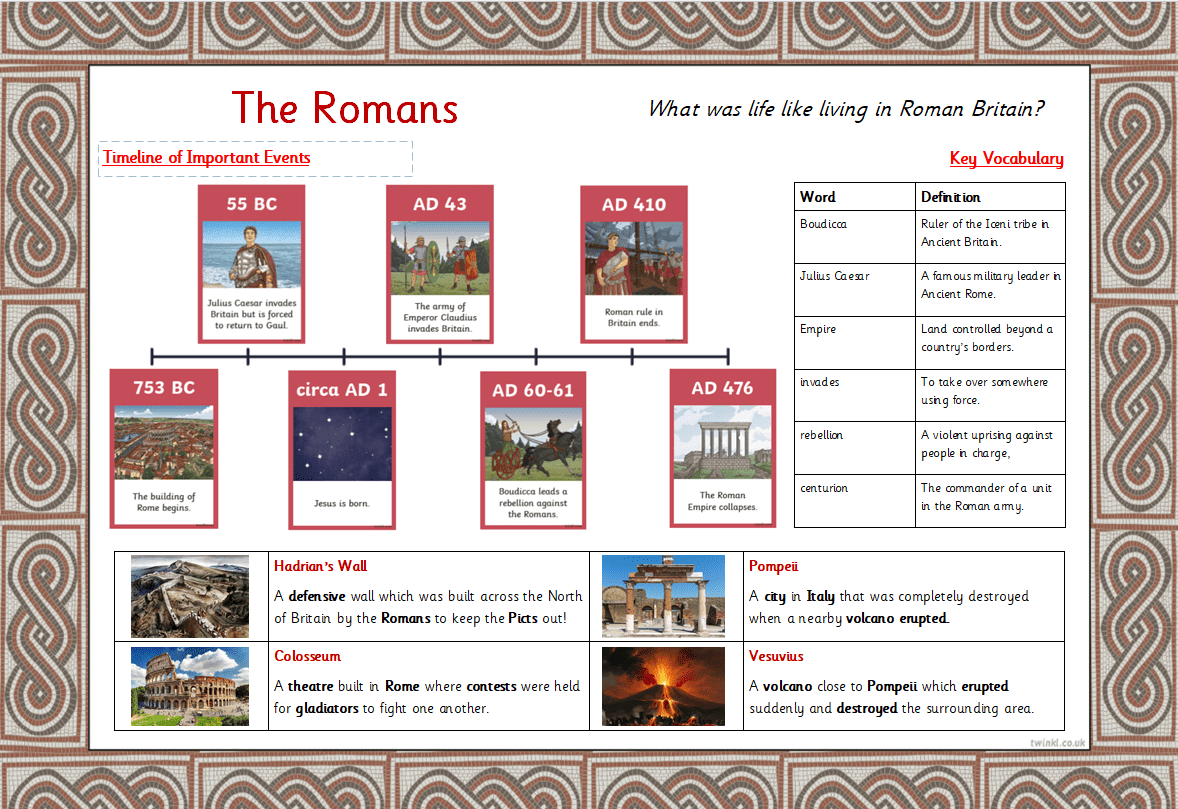
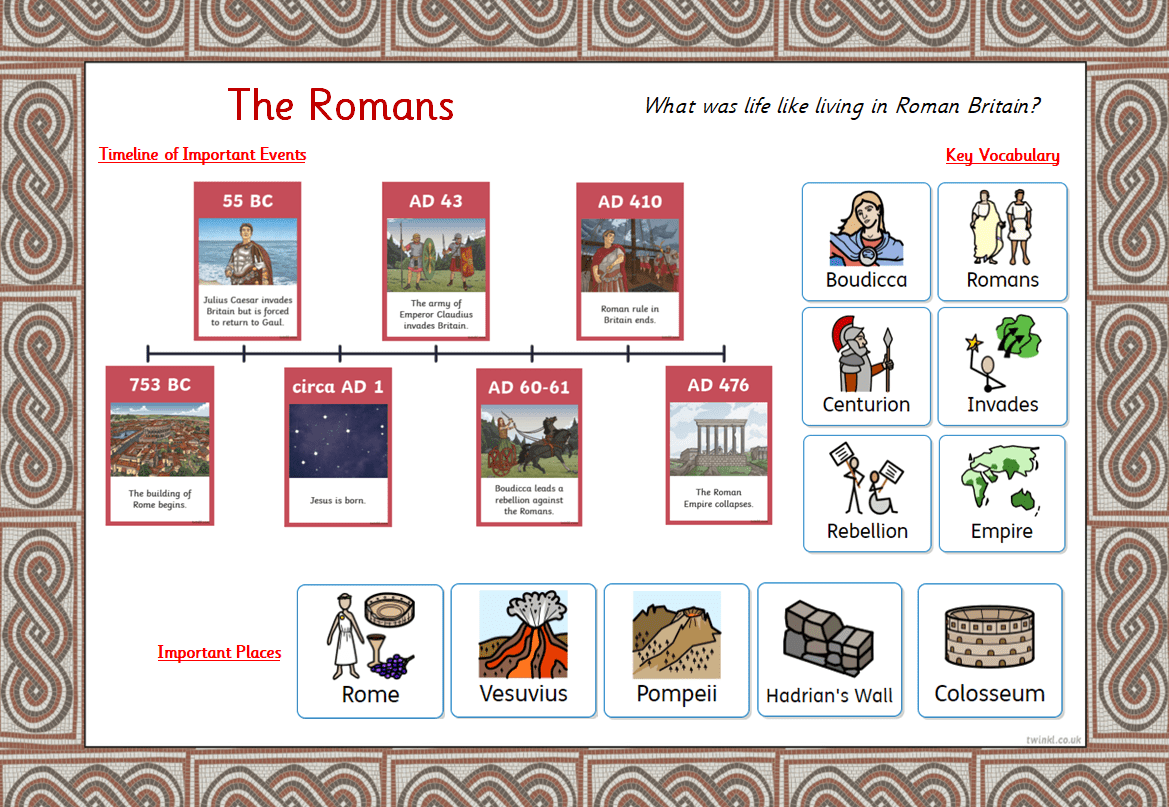
To launch our Romans topic we explored an aspect of Roman art work – mosaic. We used strips of paper to decorate our initials in this style. We have been considering the Roman legacy in Britain. We were amazed to discover that it was the Romans who taught us how to make glass into shapes like bowls and glasses. We enjoyed exploring some artefacts to see what else we could learn about the time period and learnt more about how to use primary and secondary sources to learn about the past.
On our Roman day at Southwell Minster, we became archaeologists as we explored the site of a Roman villa and carried out our own mini excavations to find artefacts. We had already learnt a little about the armour and how it helped a soldier become a successful warrior so had fun marching around the site together.
To link back to our Stone Age to Iron Age topic, we looked at the changes that took place when the Romans began to build settlements in Britain. We carefully observed images to help us draw out the similarities and differences. We also learnt about the key historical figures of Boudicca and Hadrian and how they impacted the Roman invasion in different ways leaving a legacy behind them.
Finally, we looked at their wider legacy rating each with the importance we felt it deserved. We were able to give reasons for our choices debating which was the most important change the Romans brought to Britain.
RE
In RE we have been learning about inspirational leaders from different world religions. We thought about Moses, Jesus and Mohammad (PBUH), reading stories about each of these leaders helped us to identify the qualities they showed that made them leaders and inspired others. We also asked ourselves if these were qualities we admired and if we were inspired to adopt these traits into our daily lives.
Music
In Music, we have learnt about the types of instruments and musical structures used in traditional Indian music. Using glockenspiels, hand percussions and our voices we learnt how to create a drone, rag and tal and play these together to create our own piece of music in this style.
Writing
Using the Romans as our inspiration, we have been writing explanation texts. We used our knowledge from our Roman experience day, shared reading materials and history lessons to explain why the Roman army was so successful. We used drama to explore how it would have felt to be a member of one of the powerful legions. We made sure to include some key features of the text type to fit our writing to the genre – subheadings and diagrams added detail and helped our work appeal to our audience. In summer 2, we read “Escape from Pompeii” and put ourselves into the shoes of the characters of Tranio and Livia. We followed the timeline of the events and watched videos to help us understand how the city was destroyed. This helped us to take on the roles during drama work and to describe the setting before and during the disaster. We used some amazing vocabulary to write a diary of the eruption, imagining that we were there.
Science
This term we have been studying light. We have learned about how light travels and how this helps us to see. We have defined what the words transparent, translucent and opaque mean. We also investigated how light is reflected, or not, from different materials. Then, we applied this knowledge to explain how shadows are formed. We then made a show puppet and investigated how the position of the puppet relative to the light source affected the size of the shadow.
DT
We have been exploring paper mechanisms. At first, we looked at different mechanisms and “pop ups” in books designed for children. Next, we had a go at solving the problem of how to make our own mechanism. Our next task was to practise making different mechanism. We decided to use our skills of making mechanisms to advertise gladiator games in Rome. We decided on our design before making, combining and evaluating our posters.
Art
Our Art this term has been based around sketching techniques. We began by looking at an appraising the work of Canaletto. We discussed how he would have made careful observations of his surrounding and make preliminary sketches to help him produce his final paintings. Then, we looked at the different types of sketching pencils and explored the different tones we create using them. After that, we investigated and practised different sketching techniques such as cross hatching. We practised using these techniques to sketch Roman buildings before we drew pictures of modern-day buildings in Nottingham – inspired by the landscapes painted by Canaletto.
Computing
In our Computing lessons, we used the iPads and a stop-motion animation app to create our own animations. We developed our skills each week, going from 2D drawings, to 2D moving characters, before moving into 3D story telling using LEGO characters and blocks. We also continued to improve our programming and coding skills on Scratch, by creating a working ‘Escape the Maze’ game which used a variety of different coding blocks. We even had a go at debugging our code to check that it worked correctly.


Spring 2
Geography
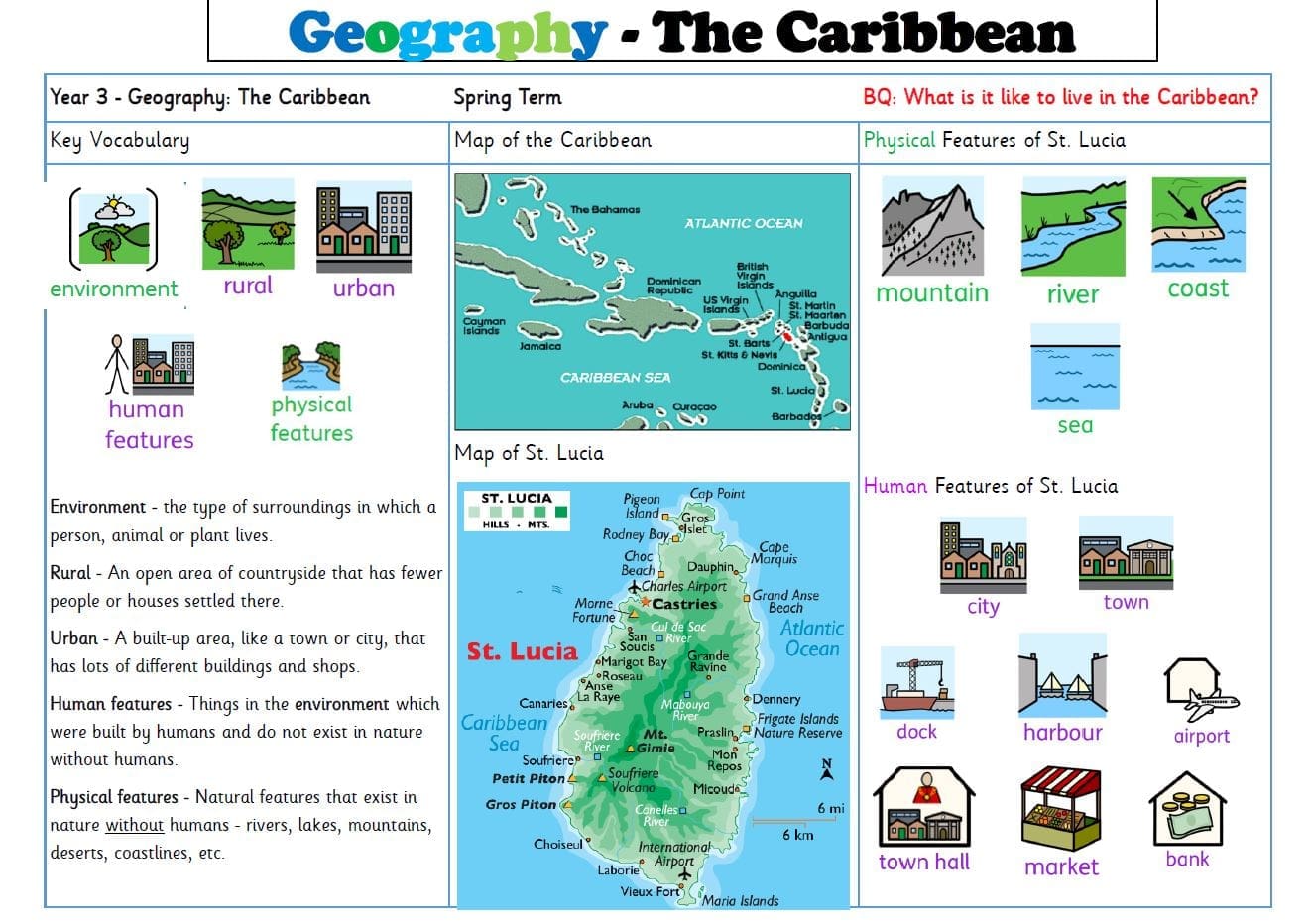
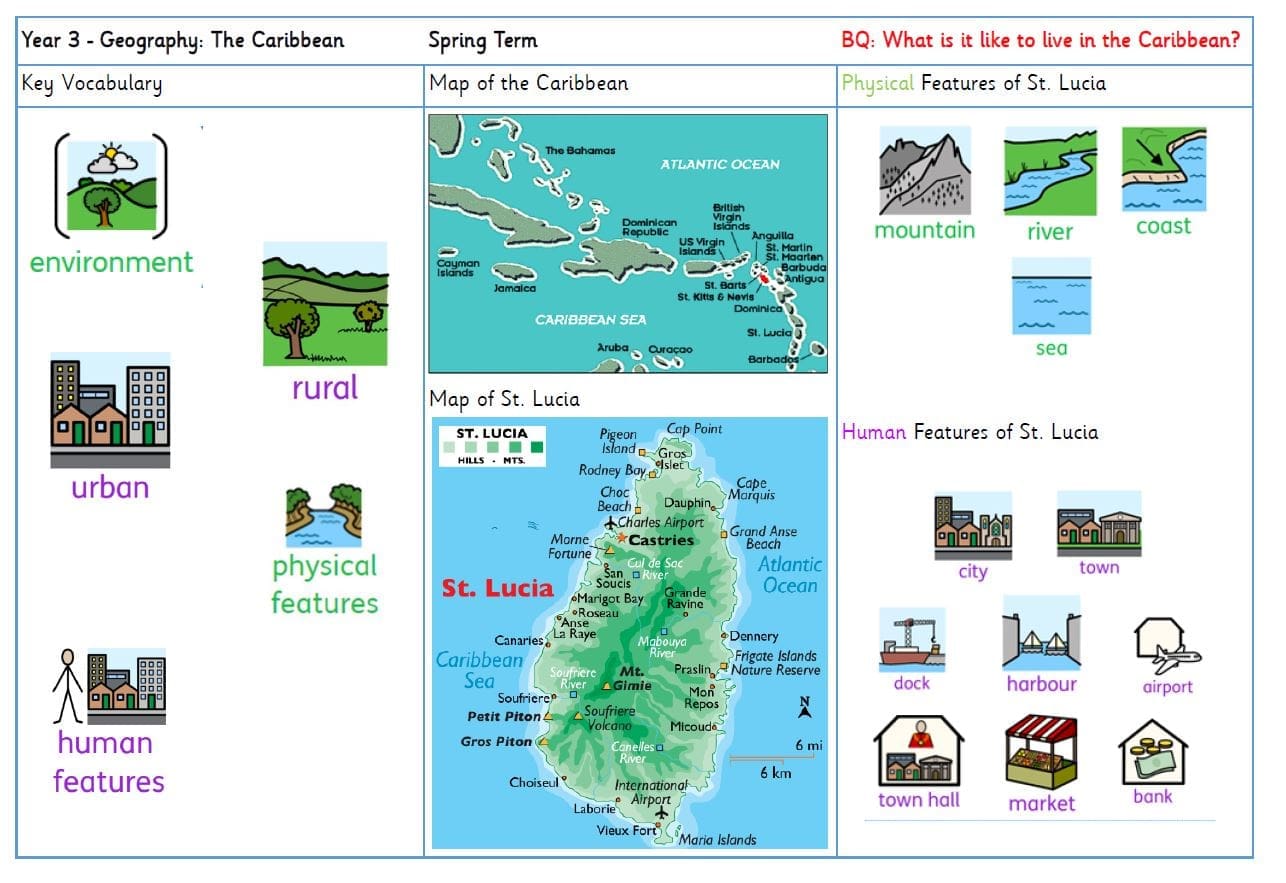
To extend our knowledge and understanding of North America we zoomed in to focus on the region of the Caribbean. To launch our learning, we learnt about carnival celebrations across different countries. We had a great time listening to different types of music including steel pans, reggae and chutney. Then we used bright colours and streamers to decorate our own carnival masks.
This term we have been consolidating our knowledge of the seven continents, five oceans and their positions on the globe. We spent time showing what we had learnt labelling each of the key locations on a world map.
To develop our skills of sketch maps we used atlas images to help us draw and label our own maps of the Caribbean. We had to think carefully about the position, shape and size of each island as we drew.
Throughout key stage 1 we have built our knowledge of physical and human features. In year 3 we use this knowledge to help us compare different locations. We focussed on St Lucia, a Caribbean Island, and compare it to Nottingham. We found that many human features were the same but the physical features were very different.
Next, we moved on to look at the impact the tropical climate of the region can have on the people who live there. We discussed natural disasters, looked at how people prepare for these and considered how it would feel to live in a country that experiences lots of these events and made hurricanes in a jar to look at the shape and movement of this extreme weather.
DT
In DT we built on our knowledge of proteins, carbohydrates and other food groups to help us design a balanced lunch time meal. We began by tasting some new foods including feta cheese houmous and olives to help us design and make a pitta pocket. Building on the knife skills we developed in Key Stage 1 we used a bridge and claw grip to help us cut the food safely and also considered how we can maintain hygienic practise while working with food. Finally, after making and eating our creations we evaluated our products and skills.
Computing
In computing we have been using Scratch to write code. We can change the sprite and programme it to move around the screen. We changed the sprite to a saxophone and programmed it to play Twinkle Twinkle Little Star. We then continued to use our coding skills to alter the background and use different sprites to play music!
Science
In science we have been learning about plants. Our “Big Question” was: Why do plants have flowers? Firstly, we reviewed our previous learning by naming the external parts of a flowering plant. Then, we described the function of each part. Next, we dissected some tulips to investigate the internal parts of a flowering plant before labelling them and describing their function. We then learned about how flowers are designed to attract pollinators and how they pollinate flowers. Using this knowledge, we discussed how seeds are formed and dispersed as part of the life cycle of a flowering plant. We will continue this unit into the start of the summer term where we will investigate how water is transported around a flowering plant.
English
In our English sessions we were inspired by some carnival themed poems. We read, enjoyed and performed a mixture of works before writing our own list poems based on a carnival performer. Then we read Drum Dream Girl by Margarita Engle and Rafael Lopez. This is the true story of Millo Castro Zaldarriaga who overcame prejudice in 1930s Cuba to learn, play and perform the drums. We used drama techniques to empathise with her and discussed whether girls and boys should be given equal opportunities. Inspired by her story, we wrote descriptions of her resilience and determination to play the drums as we retold her story.
Spring 1
Geography
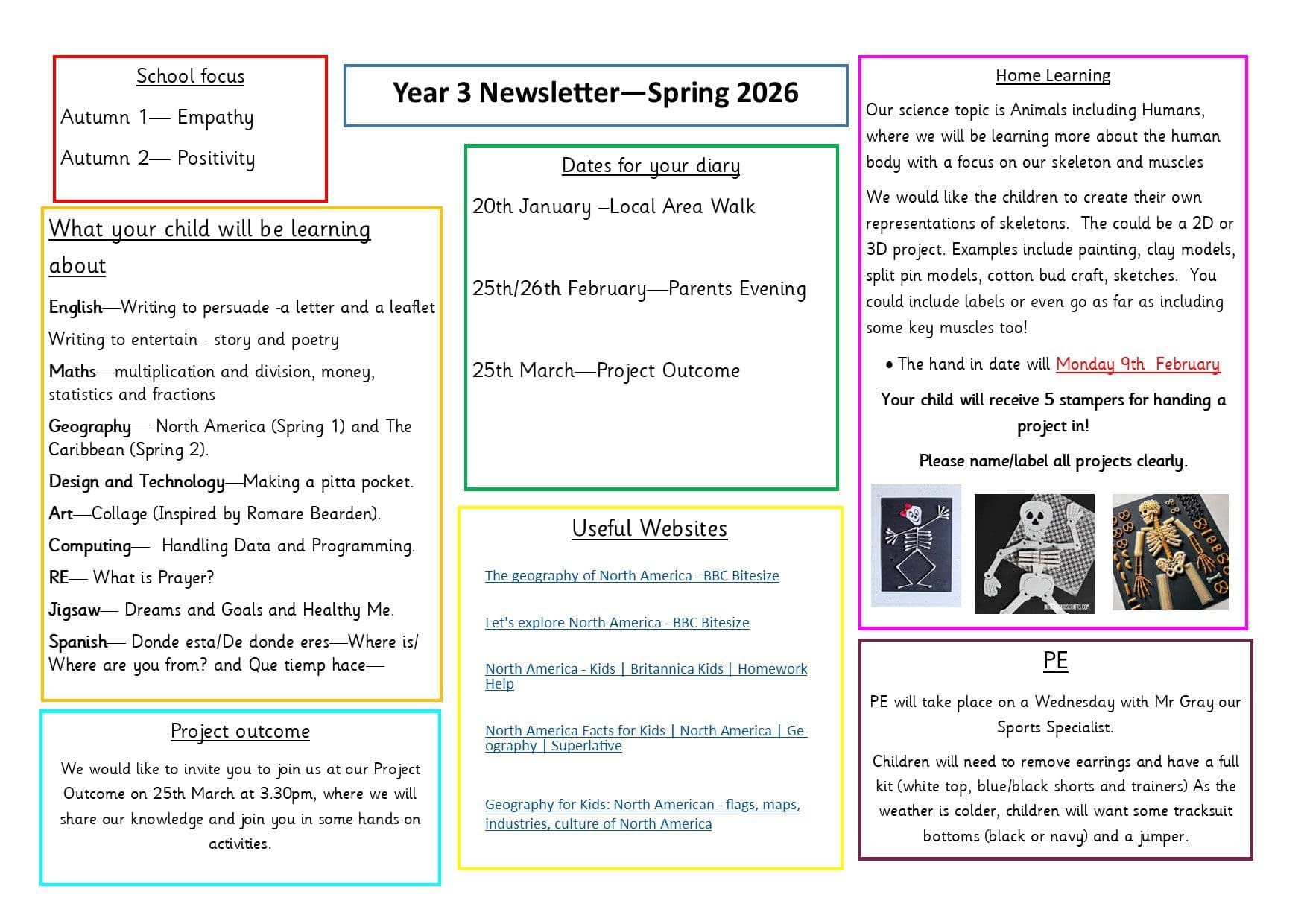
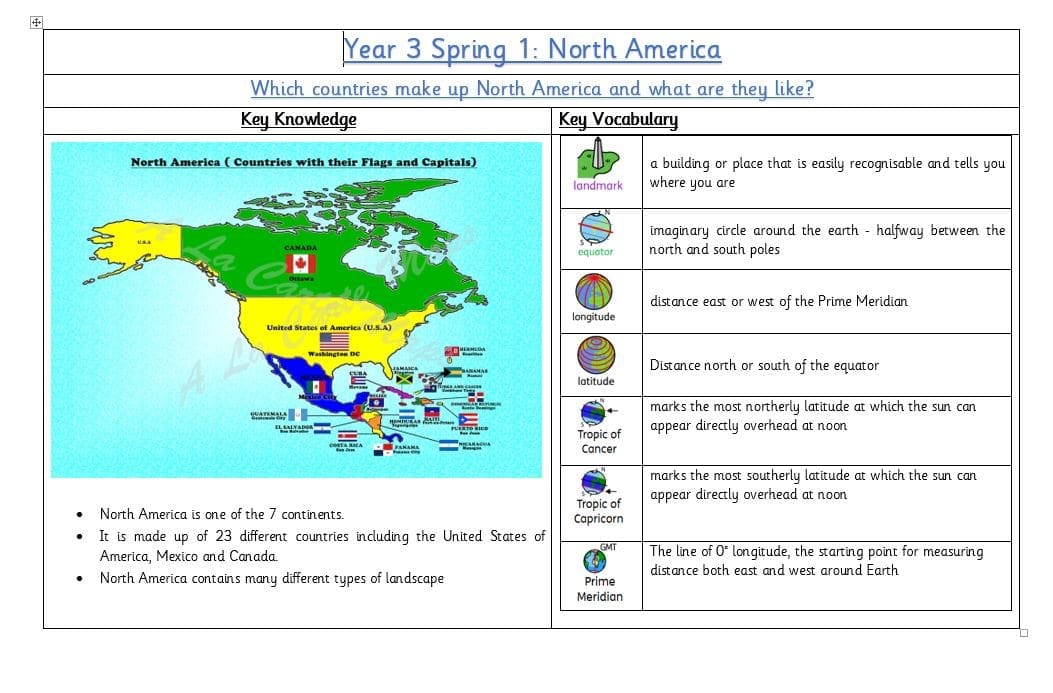
We launched our topic with a photograph mystery. We had images of different places in North America which we had to match to a large map of the continent. We were surprised to see cities, ice, waterfalls and rainforests all belonged in the same continent.
We had fun looking at webcams in Times Square, Mexico, Canada and the Caribbean. In some places it was very early morning and people were just beginning their day and in others it was the middle of the night!
We looked closely at Ordnance survey maps and noticed blue icons. We learnt that these are symbols that give information about key features in a simple, easy to understand way. We had fun trying to work out what the symbols were trying to tell us.
On a walk of the local area, we followed the route we took on Ordnance survey maps and stopped at key points to add the missing Ordnance symbols. This included the car parks, the church and a recreation area. We even identified a spot that could be a view point for the area.
We focussed our map skills on learning the 23 countries that make up North America. First, we looked at different maps of the continent and shared our views on which version would be the best to help us identify the information we needed. Some were very busy so although they looked interesting, they weren’t the most helpful.
We used our chosen map to help us label an outline and had a go at drawing our own maps of the continent.
We looked at New York and compared it to Rise Park, we thought about landmarks, entertainment and recreation. There were some very big differences and we gave reasons for which place we would rather spend a week.
Finally, we looked in detail at the different climate types. We learnt what each type was like and used our map reading skills to identify the climate in several different places across the continent.
Science
We have been investigating the human skeleton and had a go at drawing what we thought our skeleton looked like. Then used large images of bones to try and piece together a skeleton as we tried to learn the names of some of our bones.
We investigated how our muscles contract and relax to move parts of our bodies learning that muscles work in pairs and can only pull not push.
This term our investigation focussed on the body. We asked the question “Do people with longer legs jumps further?”. We made predictions, carefully measured and recorded our results and drew conclusions from our evidence. We were surprised with the outcome!
Finally, we linked previous knowledge to help us prepare for our upcoming DT project by exploring food groups and the different nutrients our body needs. We learnt about protein, carbohydrates and calcium and how each one helps our bodies.
Music
In Music, we have been listening to music linked to the Luna New Year to explore the use of a pentatonic scale.
We decorated our own dragon masks for our final performance.
Using the glockenspiels, we practised playing the notes C, D, E, G and A to perfect the scale.
Next, we made our own pentatonic melodies by mixing the notes. Finally, we brought our melodies together to create a piece called “Enter the Dragon”.
Computing
In Computing, we have been looking at branching databases which are used for sorting things like animals, food and objects. Our first task was to generate yes / no questions so we could divide the objects into two groups.
Then we identified different attributes such as colour, number of legs and number of wheels which we could ask yes / no question about e.g. Does it have 4 legs.
Finally, we have been able to use the computers to design and make out own branching databases, refining our ideas and skills as we go. We were able to sort an increasing number of subjects, in this case, dinosaurs.
English
This term we read The Tin Forest by Helen Ward and Wayne Anderson and used this as our inspiration to write persuasive texts. We began by empathising with the main character who lives by a rubbish dump. We used drama to explore his feelings and emotions and then wrote descriptions of what the dump was like.
Next, we focussed on his solution to the desolate rubbish dump – building a forest made from tin by upcycling the rubbish. We described the Tin Forest before writing persuasive letters to nature: persuading plants and animals to go and live in the Tin Forest forever.
For our second text we considered the issue of dumping rubbish and littering. We thought about our local and wider community and the impact rubbish has on the environment. We looked at some facts and statistics and developed our persuasive skills further, exploring the rule of three, rhetorical questions and exaggeration. We then used these to write a persuasive leaflet to people to persuade them to stop dropping litter ad reduce, reuse and recycle.
Art
In Art this half term we have been inspired by the work of American artist Romare Bearden. He was famous for his paintings and colleges.
Our focus has been on developing the college skills we learnt in key stage 1. We began by cutting and ripping paper to create a palm tree. Some of us were able to use layering to add depth to our trees.
With each artist we explore their work and find ways to express our opinions. We might talk about the colours, shapes or techniques they have used and share what we like and dislike about a piece of art.
Next, we looked at street scene created by Bearden and explored how he had used layers to create an image for example using a coloured rectangle for a building and then adding smaller rectangles to make windows and doors.
We used coloured paper and printed images to experiment with layers to create our own pictures.
Finally, we put all our skills together to design a Caribbean themed scene inspired by the style of Bearden.
Autumn 2
History
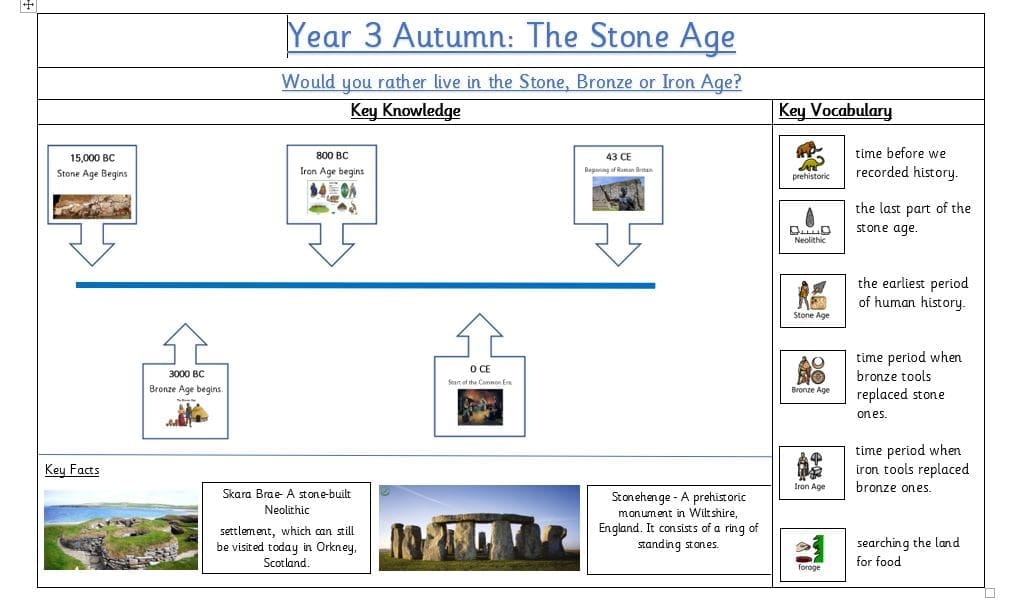
To launch our topic into the Stone Age, we asked how we know about life in prehistoric time periods. We know prehistory means before information was written down or recorded so we looked for other sources of information. We read about coprolites (fossilised poo) and were excited to receive a box of these from a Stone Age museum. We became archaeologists and made measurements of our coprolite, describe the colour and surface texture and them began to carefully excavate it to answer the question “What did Stone Age people eat?”. We discovered evidence that suggested their diet included meat and fish (we found small bones) fruit and berries (we found small seeds) and leafy plants.
After learning that early Stone Age people were known as hunter gatherers, we decided to see how easy this way of life would be. We had a list of specific items to find outside and we needed to make sure we could gather enough to feed our tribe. We also had to be alert and quiet to make sure the sabre tooth tigers didn’t sense us – some of us didn’t survive! We spent time looking at Stone Age tools using an artifact box from the museum and photographs and made comparisons with modern day versions, deciding which we would prefer to use.
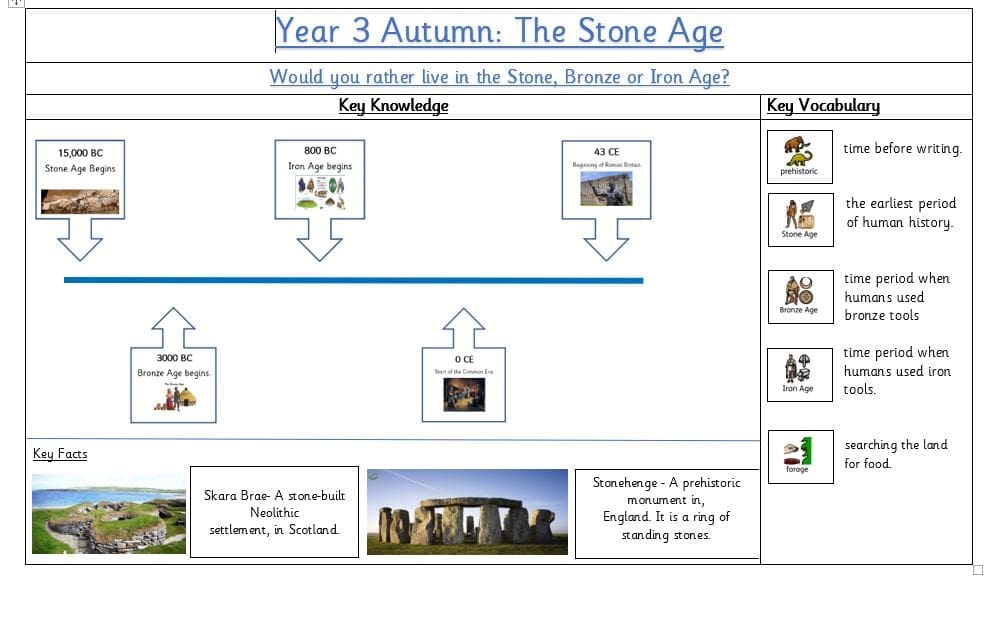
Our learning then took us to Skara Brae where we explored the remains of a Stone Age settlement, to Stonehenge where a virtual tour helped us learn about the beliefs of the people of the time and into the bronze and iron age where were learnt about the smelting process and how hillforts offered protection to a settlement.
Bestwood Park Stone Age Day
We visited Bestwood Park to experience areas of Stone Age life and were able to share many of the facts we have learnt. First, we looked at some artefacts that showed how knapping was used to change the shape of stone to make tools and talked about how this was the very start of technology. We know that Stone Age people created paintings on walls to tell stories and record important events and celebrate achievements. At Bestwood, we got to paint with our fingers to tell our own hunting stories! We were fascinated to learn that people of the time made jewellery from bones and stones and used modern tools to make our own pendants from wood. We joined a tribe and marked this on one side before drawing our own Stone Age item on the reverse. We made our own small drinking cups from clay during the day and used tools to carve patterns into the surface. We also enjoyed weaving animal pens from willow and trying out the nomadic lifestyle as we built our own shelters to protect us from a wild animal attack.
Art
Inspired by the art Sarah Morley, we have created beautiful landscape paintings. We used watercolour paints to create a wash fading the colours across the background, midground and foreground. Then, we looked at perspective to add details at different distances and finally used thicker poster paint and crumpled paper to add texture to elements of our paintings.
DT
This term our DT project has been investigating shell structures in order to make a keep-sake box. Firstly, we investigated different packaging looking at what they were used for, how they were constructed and decorated. Next, we looked at the nets of shapes especially cubes and cuboids and we discussed why many packages and boxes are this particular shape. Then, we had a go at making a protype of our box. Finally, we made our own keepsake box. Our brief was to design a box to hold a Stone Age artefact in a museum storage. Our designs reflected what artefact could be stored inside.
Science
As scientists, we have explored rocks, soils and fossils and forces and magnets. We learnt about the 3 main types of rock and how they are formed while searching for them in our immediate school environment. We explored different types of soil, making sketches of our observations and finally we used drama to act out the process of fossilisation.
In our forces topic, we began by defining a force and decided that they were a push or a pull that slowed down or sped up the movement of an object. We looked at friction and used our skills to plan and carry out an investigation into which surface creates the most friction for a toy car. We explored how magnets use a non-contact force and used iron filings to identify the magnetic field. We carried out a mini investigation to discover which materials were attracted to a magnet and challenged the misconception that all metals are magnetic. Our final investigation helped us to find the strongest magnet from a range in the classroom and discuss how magnets help us navigate the globe.
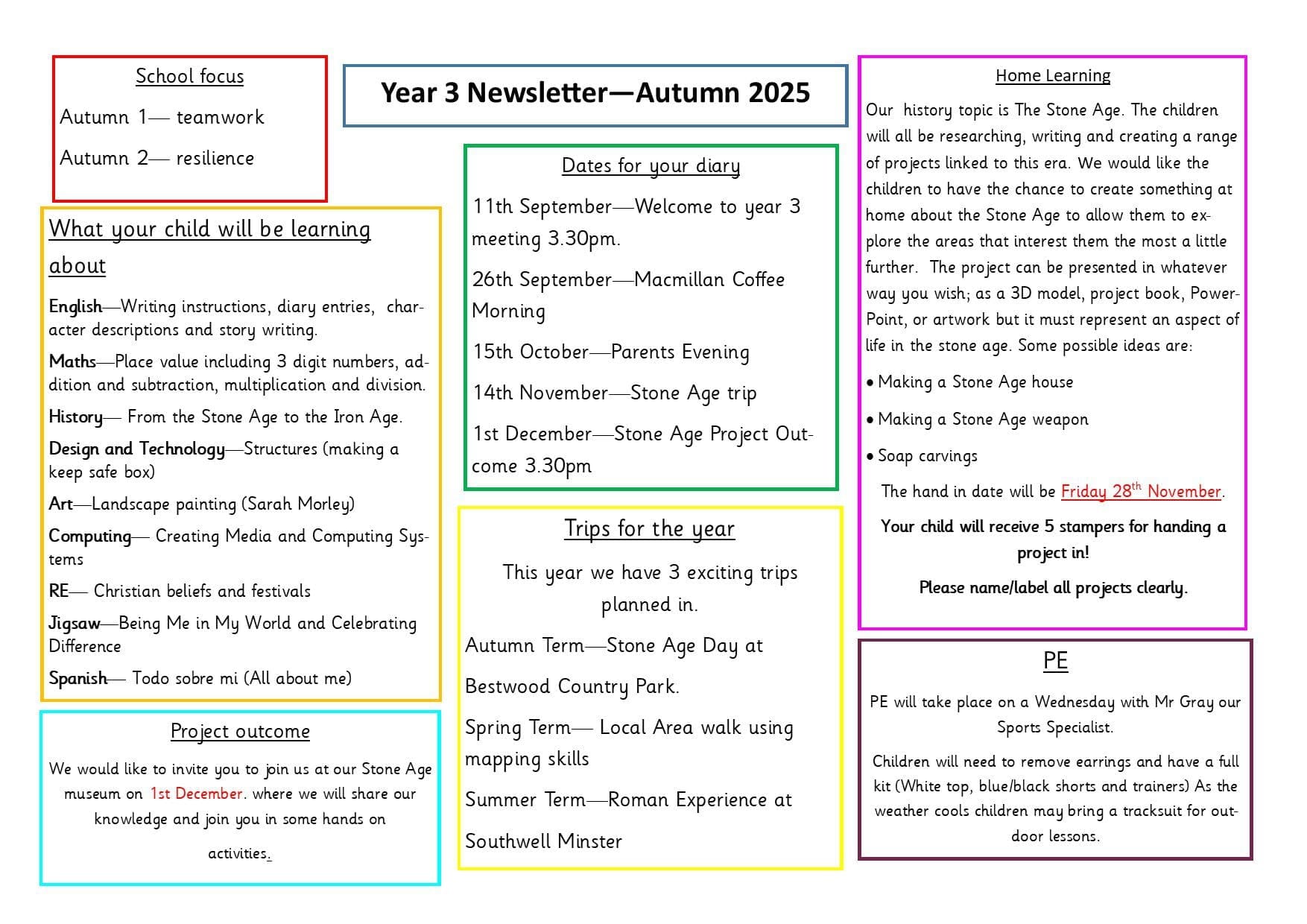
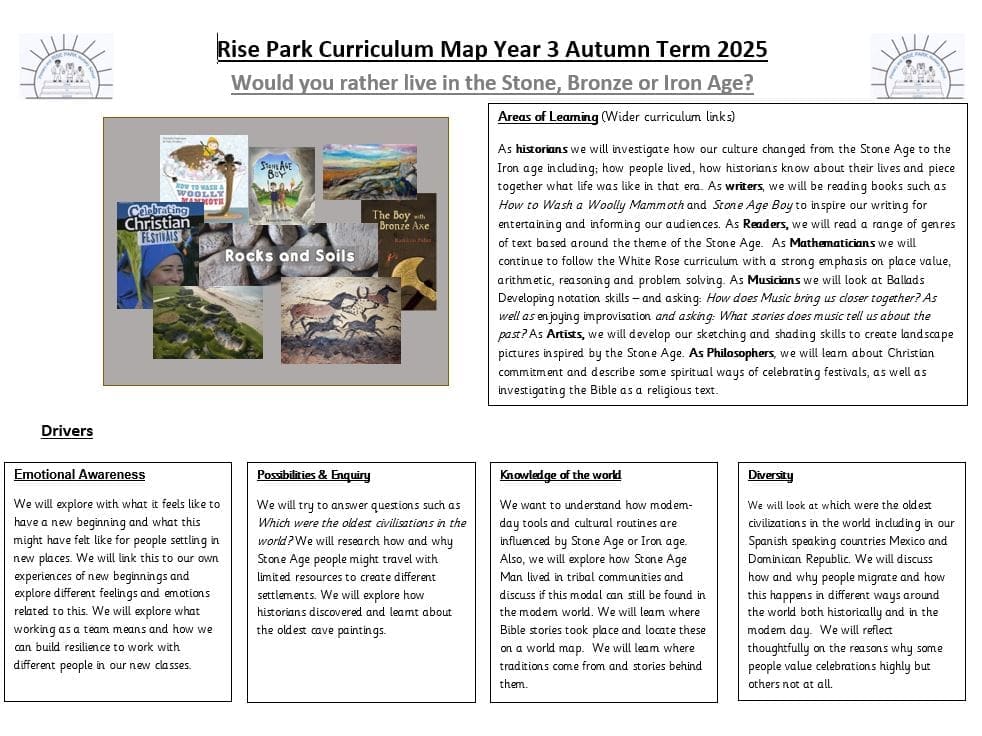
Summer 2025
History
To launch our Romans topic we explored an aspect of Roman art work – mosaic. We used strips of paper to decorate our initials in this style. We have been considering the Roman legacy in Britain. We were amazed to discovered that it was the Romans who taught us how to make glass into shapes like bowls and glasses. We enjoyed exploring some artefacts to see what else we could learn about the time period and learnt more about how to use primary and secondary sources to learn about the past. We used quotes from Caesar (a primary source) and explanation texts (a secondary source) to answer the enquiry question “What kind of a person was Julius Caesar?”
On our Roman day at Bestwood Park we became Roman soldiers, in full armour and learned how to control our shields and swords. We had already learnt a little about the armour and how it helped a soldier become a successful warrior. We learnt about marching and the formations that they used in battle. We had fun trying to build a catapult – it wasn’t as easy as it looked!
To link back to our Stone age to Iron age topic we looked at the changes that took place when the Romans began to build settlements in Britain. We carefully observed images to help us draw out the similarities and differences.
Emperor Hadrian presented us with a problem – he wanted to keep the Picts from invading Briatannia. So we worked to design a solution. We came up with the idea of a wall, which is exactly the same solution as he had all those years ago.
Finally, to share everything we have learnt about the legacy of the Romans we made posters to present our findings while deciding what we felt were the most significant changes form the time of the Romans.
Fieldwork
Our summer term project focussed on geographical enquiry. We asked the hypothetical question “Where would be the best place to build a sensory garden on our school site?”. We visited four different sites and considered the view, how accessible the area was for all learners, how easily the site could be converted and how peaceful the space was. Each focus point was given a score out of ten and we discussed and justified our reasons together. There were some very thoughtful points and we were all able to agree the best location for our hypothetical sensory space.
RE
In RE we have been learning about inspirational leaders from different world religions. We though about Moses, Jesus and Mohammad considering what qualities they showed that made them leaders. We also asked ourselves if these were qualities we admired and if we were inspired to adopt these traits into our daily lives.
We used a drama technique “Conscience Alley” to explore the choices made by Moses and reasons for an against each choice. It was interesting to put ourselves in someone else shoes. We listened to stories about Mohammad and identified how his actions show his inspired leadership.
Writing
Using the Romans as our inspiration we have been writing explanation texts. We used our knowledge from our Roman experience day, shared reading materials and history lessons to explain why the Roman army was so successful. We used drama to explore how it would have felt to be a member of one of the powerful legions.
We made sure to include some key features of the text type to fit our writing to the genre. Subheadings and diagrams added detail and helped our work appeal to our audience.
In summer 2 we read “Escape from Pompeii” and put ourselves into the shoes of the characters of Tranio and Livia. We followed the timeline of the events and watched vidoes to help us understand how the city was destroyed. This helped us to take on the roles during drama work and to describe the setting before and during the disaster. We used some amazing vocabulary to write a diary of the eruption, imagining that we were there.
Science
This term we have been studying light. We have learned about how light travels and how this helps us to see. We have defined what the words transparent, translucent and opaque mean. We also investigated how light is reflected, or not, from different materials. Then we applied this knowledge to explain how shadows are formed. We then made a show puppet and investigated how the position of the puppet relative to the light source affected the size of the shadow.
DT
We have been exploring paper mechanisms. At first, we looked at different mechanisms and “pop ups” in books designed for children. Next, we had a go at solving the problem of how to make our own mechanism. Our next task was to practise making different mechanism. We decided to use our skills of making mechanisms to advertise gladiator games in Rome. We decided on our design before making, combining and evaluating our posters.
Art
Our art has been based around sketching techniques. We began by looking at an appraising the work of Canaletto. We discussed how he would have made careful observations of his surrounding and make preliminary sketches to help him produce his final paintings. Then, we looked at the different types of sketching pencils and explored the different tones we create using them. After that, we investigated and practised different sketching techniques such as cross hatching. We practising using these techniques to sketch Roman buildings before we drew pictures of modern-day buildings in Nottingham – inspired by the landscapes painted by Canaletto.
Summer 2025