Spring 2
English
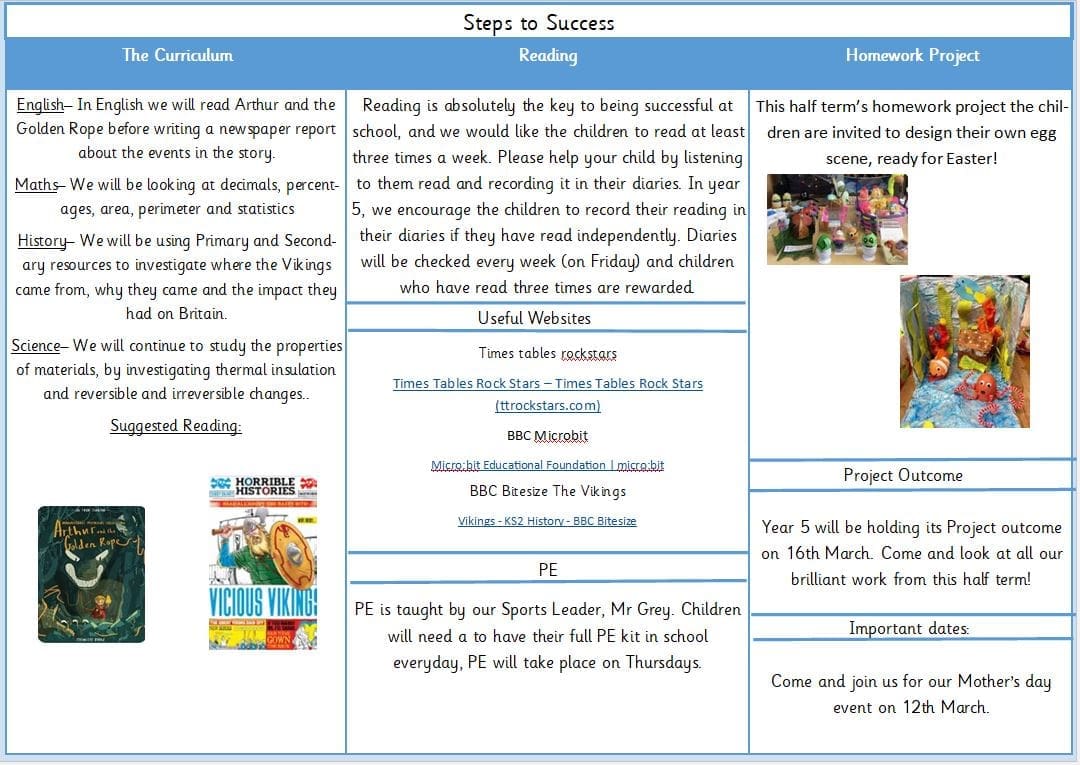
During our English lessons, we have been completing pieces of writing inspired by our topic work on The Vikings. Our first piece of writing, designed to inform, was a news report written about the story Arthur & The Golden Rope. We informed our readers about a vicious attack that had occurred when the Norse monster Fenrir appeared in a local forest.
Maths
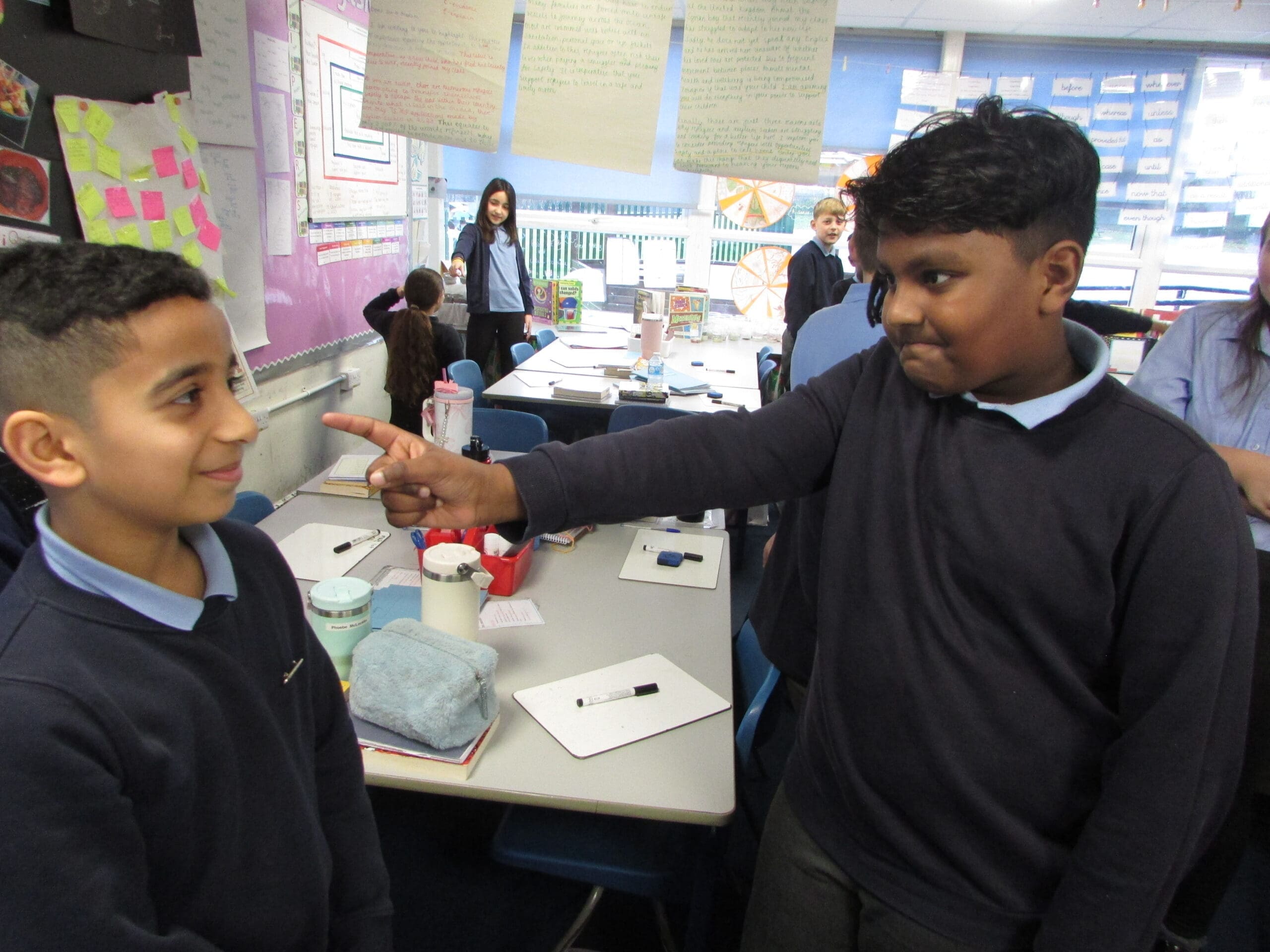
In Maths this term, we have continued to deepen our understanding of lots of different areas. We have continued to build on the children’s knowledge of decimals and fractions, whilst also introducing them to the concept of percentages for the first time. The children have also been working systematically and working backwards to solve different problems, and have drawn diagrams to help work out tricky tasks.
Science
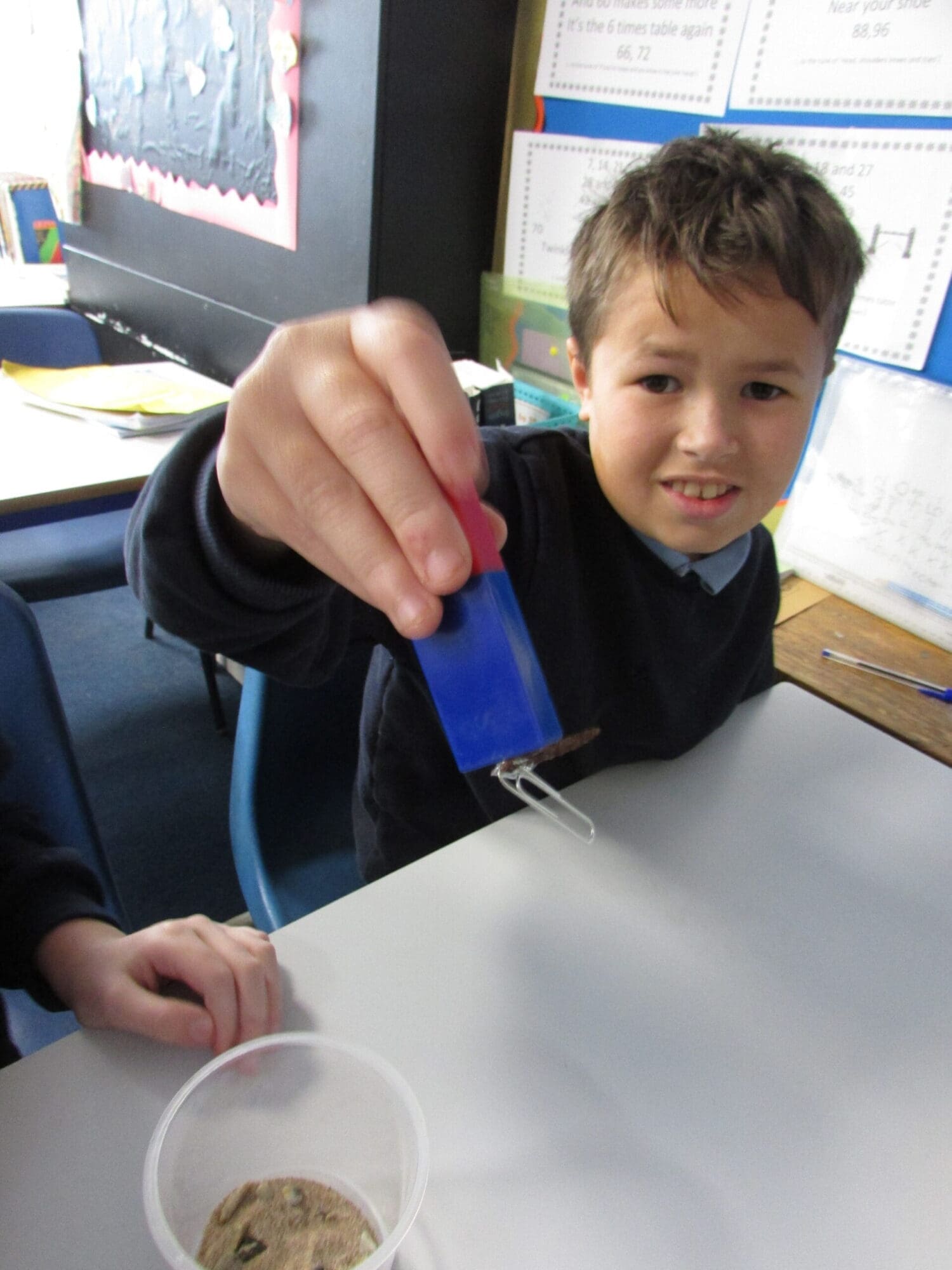
In Science lessons, we have been learning all about different materials and how they might change in different ways, including reversible and irreversible changes. This builds on work that the children last studied in Year 4. We have continued to study how filtering can be used to sort different materials, and have used our knowledge of thermal insulators to conduct experiments in class.
History
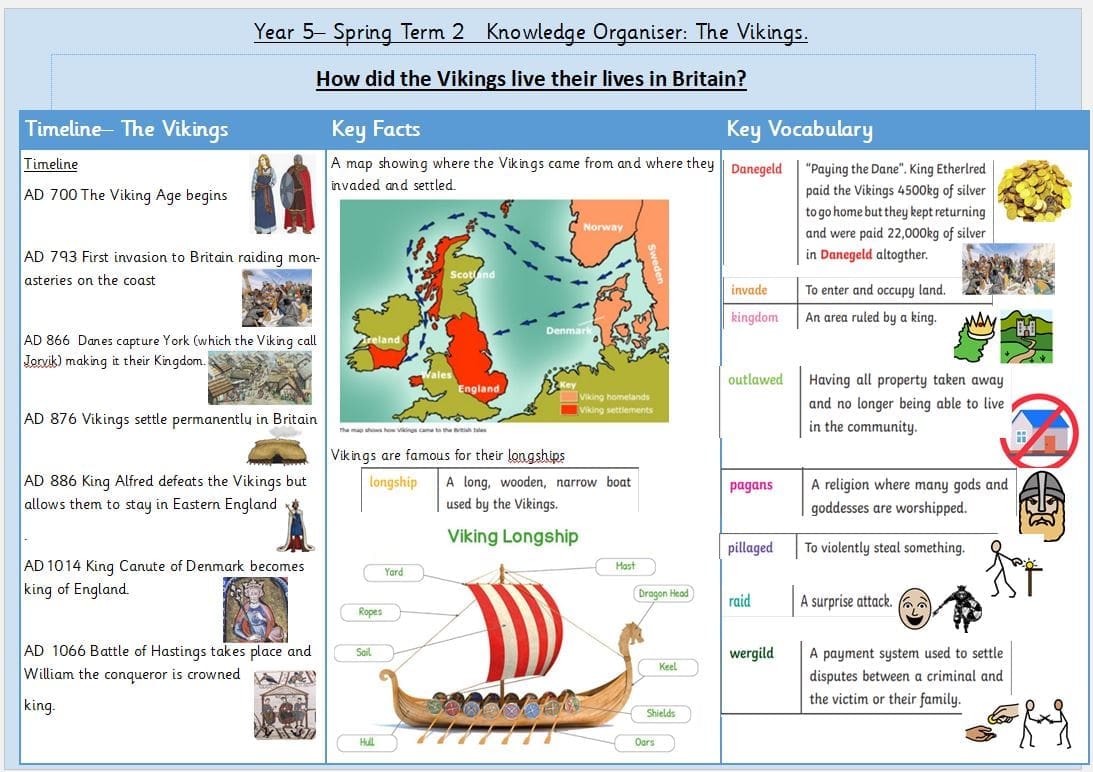
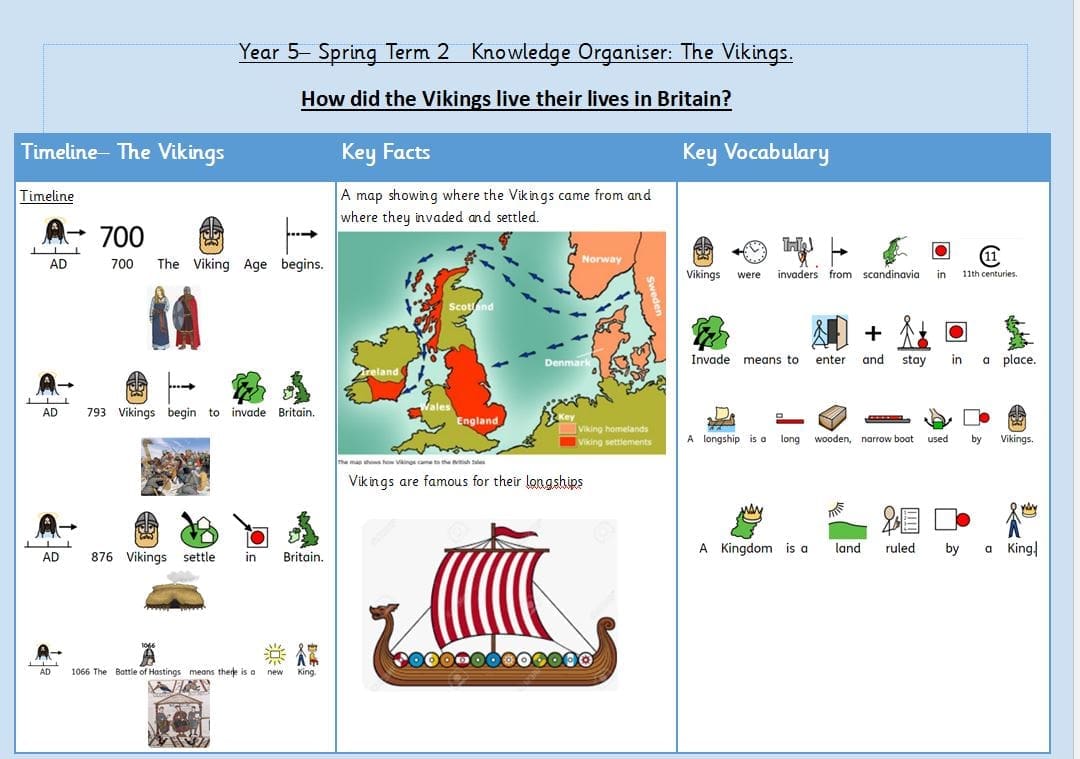
Our History topic this half-term has been all about The Vikings. We have learnt about some of the important dates, events and people that lived during the Viking period, and have made lots of links to other areas of the curriculum. Through our work in other areas of the curriculum, we have learnt about some important figures from Norse myth.
Art
In our Art lessons, we have been looking at the work of a present-day artist, Sarkasi Said, whose work with Batik relief has been inspired by his upbringing in Singapore. We studied the work of Sarkasi and used this to inspire our own designs for Batik printing and tie dye. After working on our designs, we had a go at using different relief techniques using different media. The children have worked really hard this half-term to create a piece of tie-dye, to make a wax relief and to make a masking tape relief! Using Batik techniques, the children will also create a large group piece of work to be displayed in school.
Spring 1
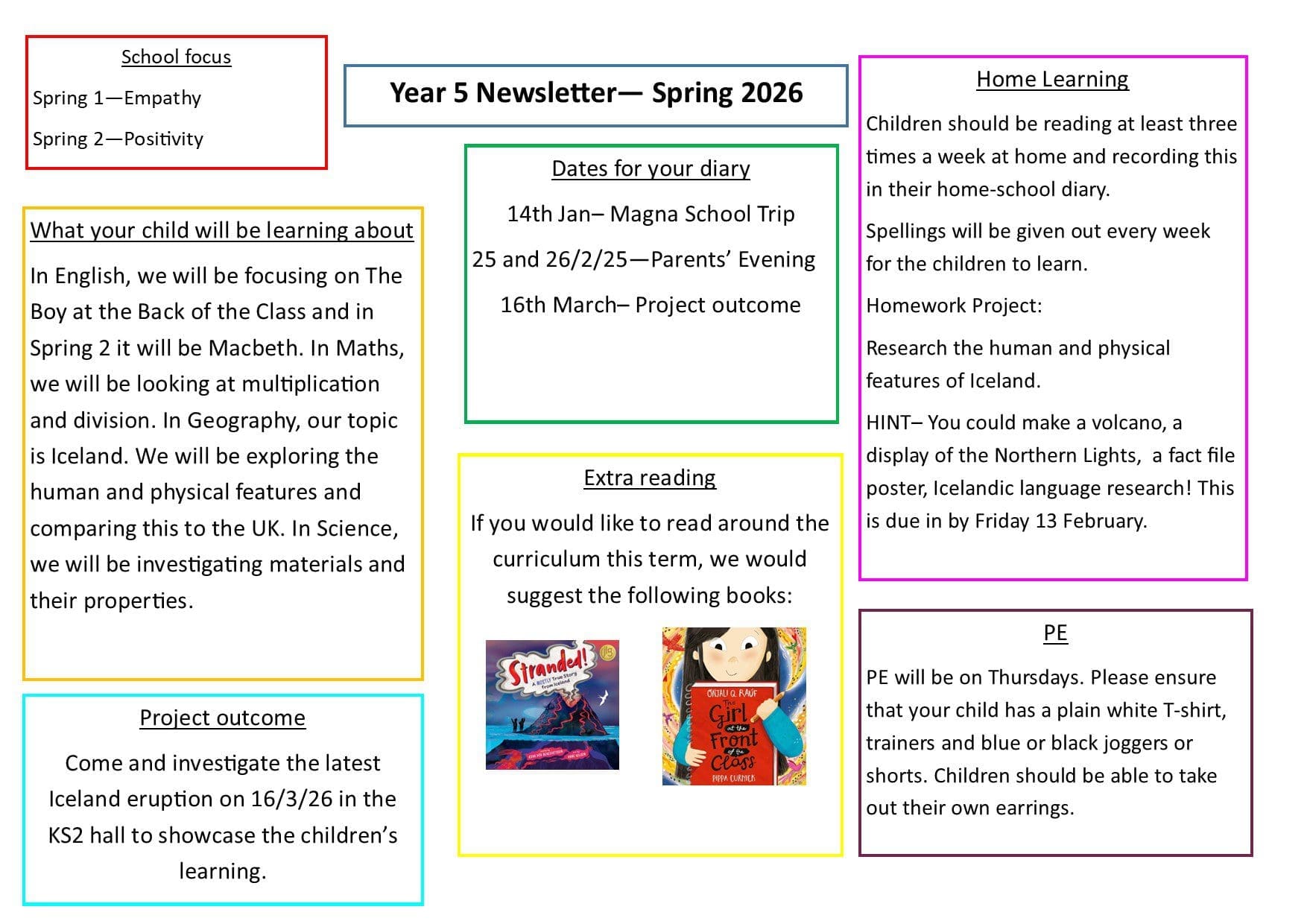
During the Spring term, Year 5 work was mainly focused around our Geography topic on Iceland. The children worked together to research the different human and physical geographical features that can be found in this European country. Together, they used digital resources such as Digimaps and Google Earth to explore the landscape of Iceland, as well as using StreetView technology to go on a ‘walking tour’ of Reykjavik. They compared these geographical features with those found in the United Kingdom, and looked at the difference between the two countries.
We have completed two pieces of persuasive writing in the first Spring half-term, written from two very different perspectives. First, the children read The Boy at the Back of the Class and learnt about the experiences of a Syrian refugee. They then wrote a letter to the Home Office, persuading them to increase the amount of aid offered to refugees and asylum seekers. The children then began looking at the story of Macbeth, written by Shakespeare, and wrote a speech from the point of view of Lady Macbeth, convincing her husband to murder the King!
The children have continued to expand their knowledge of multiplying and dividing using written methods this half term, using their skills from previous year groups to complete trickier problems. They also developed their understanding of fractions, and linked this knowledge to decimal numbers. In addition, the children learnt different problem-solving strategies with which they could begin to solve harder problems linked to different areas of the maths curriculum.
During our art lessons, year 5 have studied the Artist Sarkasi Said and the influence he had on the progression of Batik. The children used his work as inspiration to create our own versions of Batik and tie dye. The children thoroughly enjoyed learning this new skill inspired by an artist and his bright colours!
During our Computing lessons, the children began to learn about flat-file databases, first working with paper versions in class and exploring the difficulties that searching through these presents. They then moved on to using digital databases created through the J2Data website, linked to a variety of different topics such as the Titanic passenger list or minibeasts. They used the skills developed in these sessions to then conduct their own research using a real-life online database – ‘booking’ flights to different locations around the globe!

Autumn 1 and 2
In Art we were inspired by the work of Eleni Vernadaki and the ceramics left by the Ancient Greeks to design and make our own clay pot. We practised using the pinching and coiling techniques before designing our own pot. We then worked with Maria who helped us use these techniques to make and glaze our pots. They have been fired and we have been lucky enough to take our creations home!
In DT we have designed and made scones. We have tested and researched scones that are already available and inspired by the ingredients found in Greece. Also, using the ones that we sampled, we made our own designs considering ways of working hygienically and considering food allergies and intolerances. We then worked in teams to make (and taste) our scones. They were delicious!

In History, we have been learning about The Ancient Greeks. We have studied what life was like in the City States of Ancient Athens and Sparta. We investigated Ancient Greek buildings, gods and goddesses and myths and legends. We have also looked at the origins of the Olympic Games and the beliefs of the Ancient Greeks to help us answer our Big question. In order to learn about the Ancient Greeks, we have continued to develop our skills of using primary sources of evidence, artefacts such as bowls, plates coins and bottles and secondary sources like books, the internet and videos.
In Music, we listened to ‘Walk like an Egyptian’ by the Bangles to develop our singing skills. We then developed our own simple musical notation to compose a simple piece of music inspired by Ancient Egyptian hieroglyphs. Finally, we listened to a funereal march and used musical notation and the pentatonic scale.

In Science, we have been learning about forces. We have investigated friction, air and water resistance as well as gravity. We have learned how to use a force meter and used secondary sources to investigate the life of Sir Isaac Newton. We then looked at different mechanisms such as gears (including gearing up and down) levers and eventually pulleys in order to use forces to help us move and lift things using less energy or people power.
In RE, we learned about the life and work of significant leaders and explored who we found to be an inspirational person and why. We have also investigated what is important to Christians – focusing on Holy Communion.
In Maths, we have we have continued to develop our understanding of place value, rounding numbers to the nearest 10, 100 and 1000. We have also been multiplying by 10, 100 and 1000. We have continued to use formal written methods for addition and subtraction to help with problem solving. We have also been exploring fractions that are smaller and bigger than 1 through mixed numbers and improper fraction. We have learned to convert them and find common denominators when adding, subtracting and ordering fractions.

In writing, we have been inspired by the stories and characters of Ancient Greece. We have read The Adventures of Odysseus by Hugh Lipton and have written a character description of Odysseus before writing our own version of the story of Cyclops. In Autumn 1, we read ‘Who Let The Gods Out’ by Maz Evans. We have written a diary in character as Elliot and we are currently writing a wanted poster for the mischievous character of Virgo.

In PHSE, during Autumn 1, we looked at the topic ‘Being Me in My World’ where we compared our lives to others and looked at what it means to be a part of a community. We also created our own rights and responsibilities that allow us to be a part of a fair country. During Autumn 2, we have looked at ‘Celebrating Differences’ where we have explored what it means to be a part of a different culture. We have spoken about racism and bullying and how we can prevent this.

In Computing sessions, we have looked at systems. We designed our own digital ted which needed inputs, outputs and a process to work. We then looked at how systems work when it comes to operating a pelican road crossing. We compared the differences to a sensor crossing and a timer crossing to see how the systems worked differently.


Year 5; Summer Term
Geography
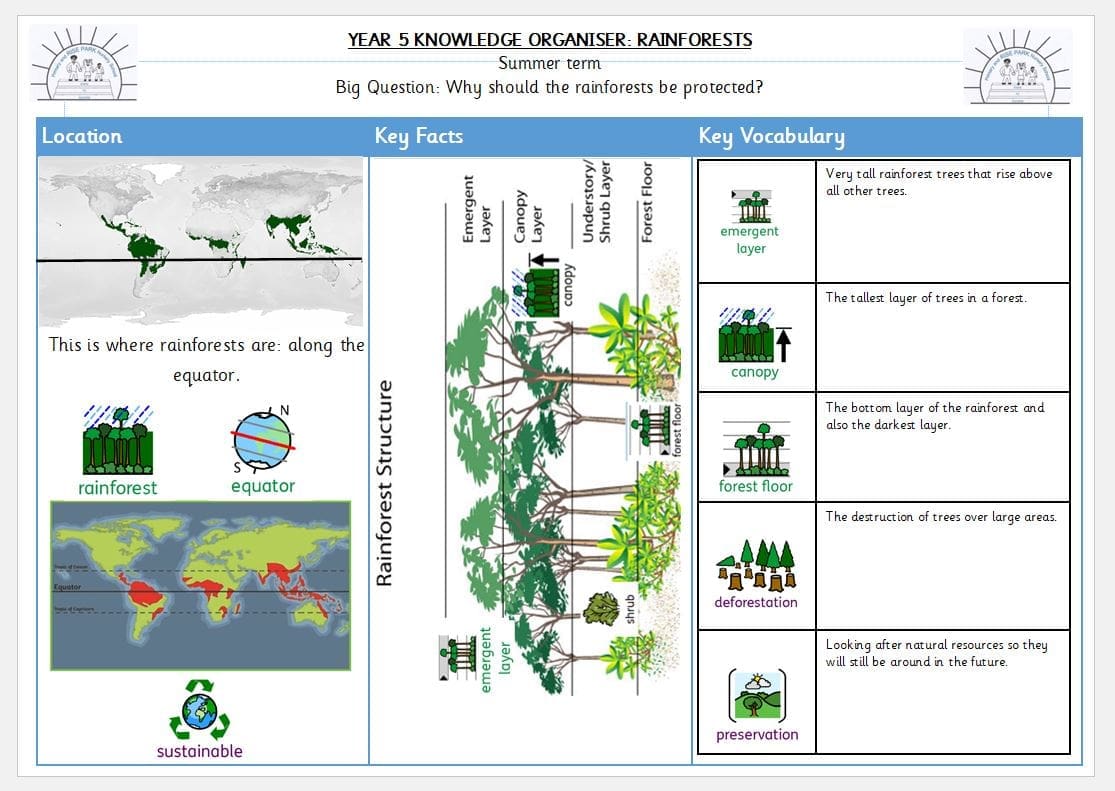
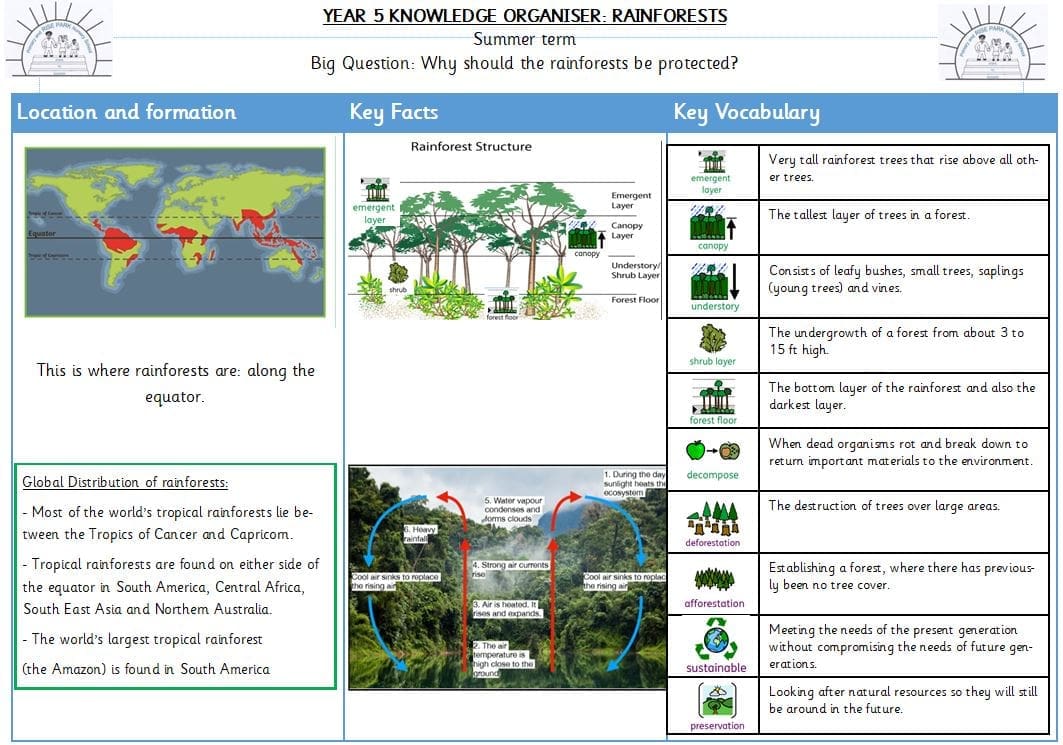
During the Summer term, year 5 have learnt about the rainforest. We have looked at rainforest biomes and where they are located and how this effects the weather there, taking into the consideration of the water cycle. Also, we have been able to identify each layer of the rainforest and what type of species may be found within each particular layer. All of this has helped us to answer the question regarding whether deforestation should be banned and how this effects different communities.
Writing
We have completed a rainforest setting description based on our class book ‘The Explorer’ and then used this to help write an adventure story using some of the characters from the book, before having a go at writing our own adventure story. Lastly, we wrote a discussion text based on whether we thought deforestation should be banned, controlled or able to continue. This was based on the book ‘Journey to the River Sea’.
Maths
In Year 5 maths during the Summer Term, we have looked at decimals and how to multiply and divide them by factors of 10. We have investigated negative numbers for the first time and linked this to real world applications of them. We have also looked at how to convert measures. We have further applied these to problem solving questions, where we have been able select the best problem-solving skill, from the toolkit, to tackle it appropriately.
Design & Technology
For design technology, we have looked at and researched different types of bridges. We have investigated the materials they are made out of, what their use is and why it is important for them to have a start and end point and be weight bearing. We then created a structure of out polyhedrons model kit. Finally, we planned our designs and created this out of cardboard as team.
Computing
During our computing sessions we have explored different ways of filming, and the angles and shots at which we can do this at. We then had a go at planning and creating a short film of our own, taking into consideration the different types of shots. After, we explored scratch where we had a different objective each lesson, regarding how we could programme our scratch to move.
Summer 2025