Computing at Rise Park 

At Rise Park, we believe that ‘a high-quality computing education equips pupils to use computational thinking and creativity to understand and change the world’. 

We equip our pupils with the skills and understanding to use a variety of computer technologies for a variety of purposes. Our computing curriculum aims to support children’s computational and critical thinking, resilience and creativity. 

Further to becoming digitally literate computational thinkers, we support our children’s safety and wellbeing through a comprehensive Online Safety curriculum, supported by Project Evolve with links to our PSHE and Computing lessons. This curriculum encourages children to make the most of technology as a force for good, while understanding it as a powerful and nuanced tool that can have both a positive and negative impact on ourselves and others.

Finally, we want our pupils to feel empowered by computing by seeing the variety of skills used within computing and the vast range of opportunities available through further study.  

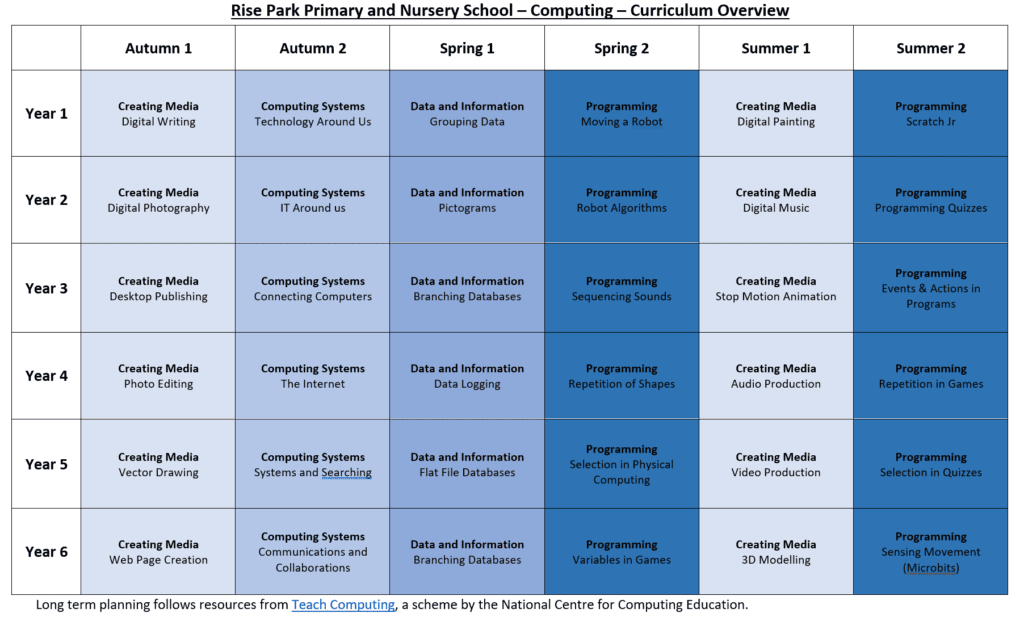
 Rise Park’s Computing curriculum is adapted to the needs of our children from Teach Computing, a scheme developed by the National Centre for Computing Education (NCCE), and supported by the Department for Education (DfE). We take a no-ceiling approach in teaching, and through open-ended tasks, pupils with SEND and the most able can achieve well.   

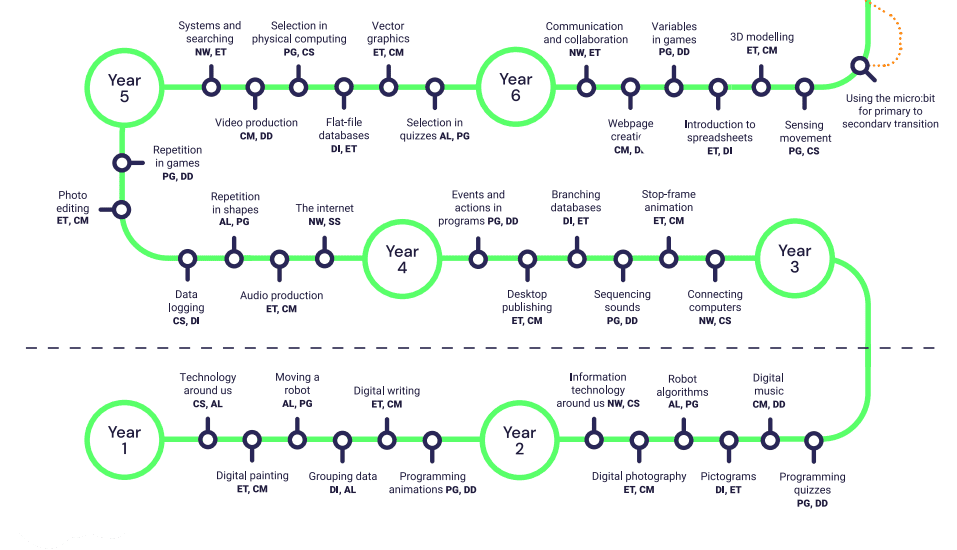
The ‘Teach Computing’ curriculum is a spiral curriculum, a curriculum design in which key concepts are presented repeatedly throughout the curriculum through years 1-6. As children progress through school, concepts become more complex and are applied in a wider variety of ways. For all learners from years 1-6, Computing is split into 4 core strands: 

  • Computing Systems and Networks 
  • Creating Media 
  • Data and Information 
  • Programming 

Computing, Online Safety And 4 Cs

Computing Systems and Networks 

Starting by learning about the range of different technology that surrounds us, our spiral curriculum circles back to build knowledge of how information technology is used in the world around us, how digital devices and how networks like the internet operate, and why they are vital to the functioning of the modern world. 

Creating Media  

Through the Creating Media strand, children get to show their creative side in a variety of ways. Using a range of appropriate hardware, including iPads, cameras and laptops, children have the opportunity to practise photography, produce digital paintings/artwork, publish posters and other documents, create stop motion animations, make short films and even record audio to create a podcast. 

Data and Information 

The data and information strand builds on children’s statistics learning and maths. Learners experience a variety of ways to record, interpret and present data, including using a variety of hardware to log data, such as temperature or sound, before presenting it in tables or graphs using digital tools. Y6 children have even used Microsoft Excel to forecast and model finances for their community fundraising projects, providing them for a real ‘why’ for their work. 

Programming 

From the get-go in KS1, children are exposed to coding using ‘BeeBots’ and similar robotic coding devices. These physical resources allow children to begin thinking computationally and sequentially, creating simple programs to move their robot around the room. When things go wrong, children independently troubleshoot their code, changing it in the moment before testing it again. As children progress through the school, children code in a variety of ways, using programs such as Logo and Scratch. In years 5 and 6, children have the opportunity to use MicroBit Devices to create a variety of useful tools such games, data collection devices (sensors) and even a smart watch.